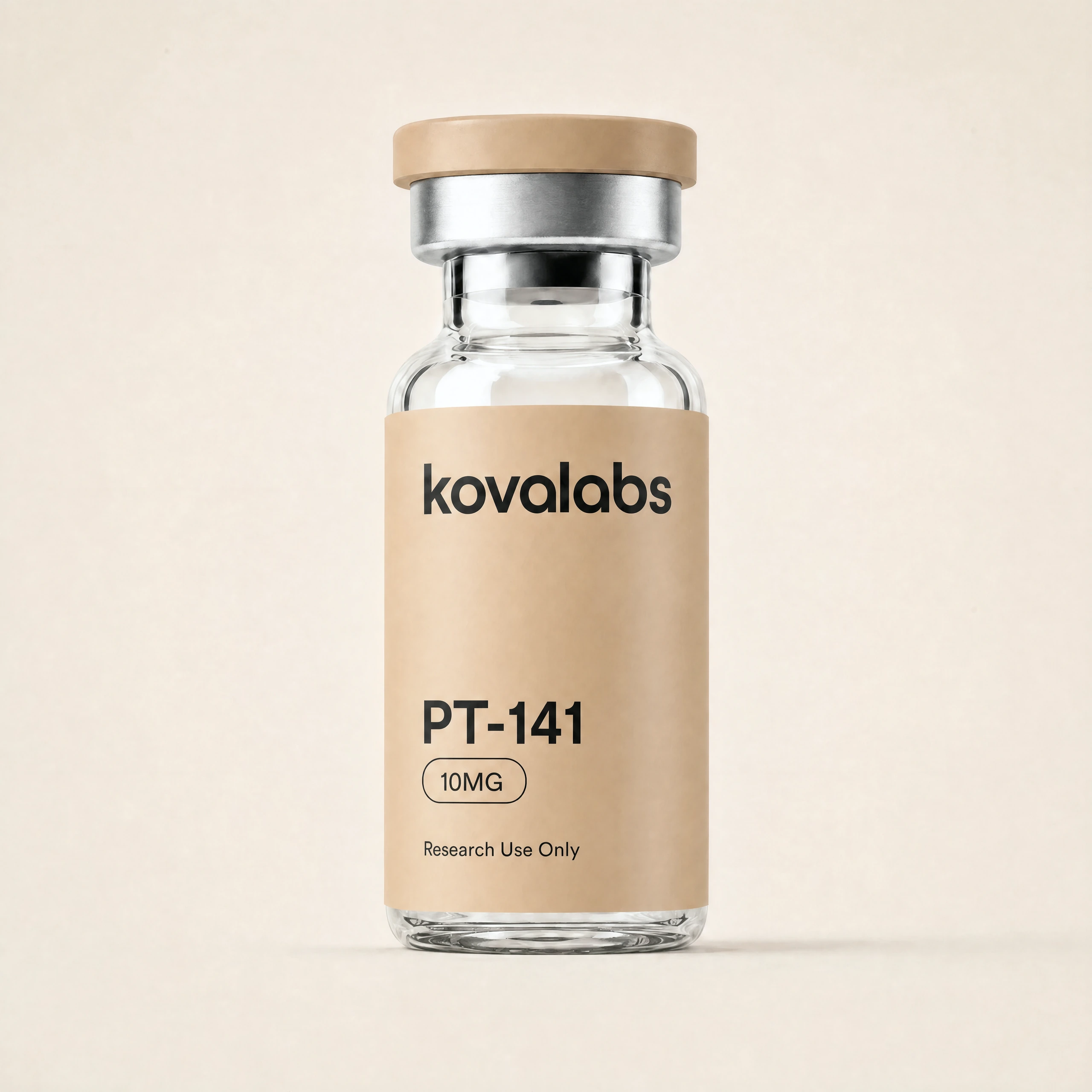
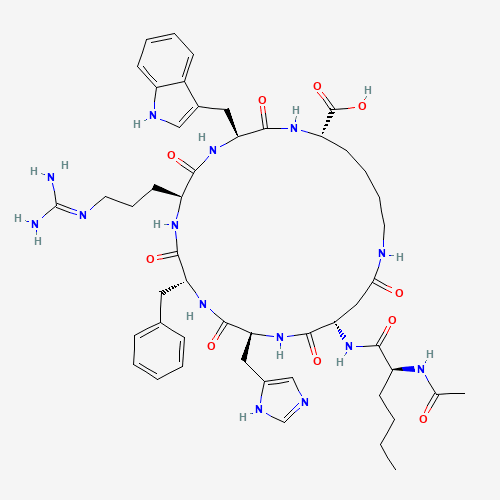
- What is PT-141?
- PT-141 is bremelanotide, a synthetic cyclic heptapeptide and melanocortin-receptor ligand structurally related to melanotan II. Its molecular formula is C50H68N14O10, molecular weight 1025.2 g/mol, and CAS number 189691-06-3, with the sequence Ac-Nle-cyclo[Asp-His-D-Phe-Arg-Trp-Lys]-OH. Kovalabs supplies it as a lyophilised reference compound for laboratory research use only.
- Is PT-141 legal in the UK?
- PT-141 (bremelanotide) is not a controlled drug under the Misuse of Drugs Act 1971, so it can be bought and held in the UK for legitimate laboratory research. It is supplied strictly for research use only, not for human or veterinary consumption. The buyer is responsible for lawful and appropriate handling and use of the material.
- Is PT-141 for human use?
- No. PT-141 is supplied solely as a reference chemical for in-vitro and pre-clinical laboratory research. It is not a dietary supplement, a cosmetic or a product for human or veterinary use, and it is not supplied for and must not be used for any human application. No route, dose or human use is described, recommended or implied.
- Is PT-141 sold for human arousal-related use?
- No. PT-141 is supplied for laboratory research use only. It is not sold for, marketed for, or to be used for any human purpose, including any sexual or arousal-related use. Kovalabs makes no claim of any human effect. The material is a reference compound for non-clinical investigation and nothing more.
- What are the molecular identifiers for PT-141?
- PT-141 has the molecular formula C50H68N14O10 and a molecular weight of 1025.2 g/mol. Its CAS number is 189691-06-3 and its PubChem CID is 9941379. The peptide sequence is Ac-Nle-cyclo[Asp-His-D-Phe-Arg-Trp-Lys]-OH. These identifiers let researchers confirm they are working with the correct compound.
- Is all PT-141 the same?
- No. Material sold under the same name can differ in identity and purity. That is why every Kovalabs batch is released only after independent testing, with purity assessed by HPLC at 99% and identity confirmed by HPLC retention-time matching (HPLC-RTM) against a reference standard and published identifiers. A current certificate of analysis, available on our CoA page, is how purity and identity are demonstrated rather than assumed.
- How is PT-141 supplied and reconstituted?
- PT-141 is supplied as a lyophilised powder, a white to off-white solid, despatched from the UK. For laboratory handling it is reconstituted in a compatible solvent such as bacteriostatic water. Reconstitution is a bench preparation step only: no route of administration, dose or human use is described, recommended or implied by Kovalabs.
- How should PT-141 be stored?
- Store the lyophilised PT-141 solid at -20C, kept dry and protected from light, to maintain stability. Once reconstituted in a compatible solvent for laboratory work, hold the material at 2-8C. Proper storage helps preserve identity and purity over the working life of the vial. The compound is for laboratory research use only.
- Does PT-141 come with a certificate of analysis?
- Yes. Each batch is released after independent identity and purity testing, and a batch certificate of analysis is available on our CoA page. The CoA reports HPLC purity of 99% and confirms identity by HPLC retention-time matching (HPLC-RTM) against a reference standard for C50H68N14O10, so researchers can verify the material before use.
- Is PT-141 a peptide?
- Yes. PT-141 (bremelanotide) is a synthetic cyclic heptapeptide, meaning it is a short chain of seven amino acid residues arranged in a ring. Its sequence is Ac-Nle-cyclo[Asp-His-D-Phe-Arg-Trp-Lys]-OH. It is classified as a melanocortin-receptor ligand and is supplied as a lyophilised research-grade peptide for laboratory use only.
- How does PT-141 compare to Melanotan 2?
- Both are synthetic melanocortin peptides studied at the melanocortin receptors, and PT-141 is structurally related to melanotan II. They are nonetheless distinct molecules with different sequences and CAS numbers. This comparison describes what the molecules are as research chemicals only and does not describe or imply any human effect. See the melanocortins category for the full research range.