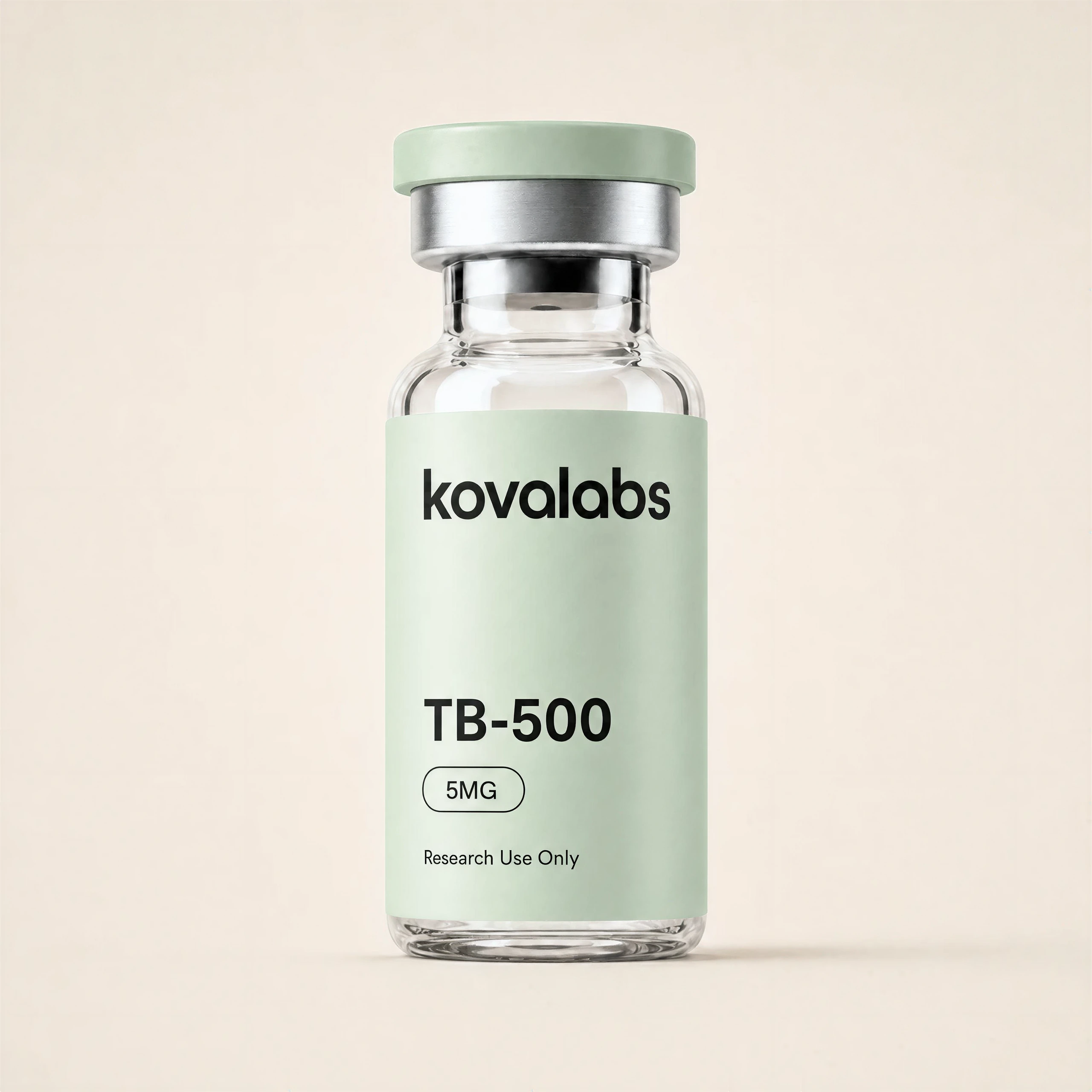
- What is TB-500?
- Our TB-500 is full-length synthetic thymosin beta-4 (TB-4): the complete 43-amino-acid, N-terminally acetylated peptide. It has the formula C212H350N56O78S, a molecular weight of about 4963 g/mol, and CAS number 77591-33-4. It is supplied as a lyophilised powder for laboratory research only.
- Is TB-500 the same as thymosin beta-4 (TB-4)?
- At Kovalabs, yes. The TB-500 name is used for two materials across the market: the full 43-residue thymosin beta-4, and a short 7-residue fragment (Ac-LKKTETQ). We supply the full-length thymosin beta-4, and our Certificates of Analysis confirm identity against a TB-4 reference standard.
- What is the difference between TB-4 and the TB-500 fragment?
- The fragment, Ac-LKKTETQ, is just 7 residues (17 to 23) of thymosin beta-4, about 889 g/mol. Full-length thymosin beta-4 is the complete 43-residue peptide the fragment is cut from, about 4963 g/mol. They are different compounds and are not interchangeable. Kovalabs supplies the full-length peptide.
- Is TB 500 legal in the UK?
- TB-500 is not a controlled drug under the Misuse of Drugs Act 1971 and is not a licensed medicine. It is sold strictly as a research chemical and cannot lawfully be supplied for human consumption. Responsibility for lawful handling rests with the purchaser. See our research disclaimer for the full terms.
- Is TB 500 intended for human use?
- No. TB-500 is supplied for in vitro and laboratory research use only. It is not a food, supplement or medicine, is not intended for human or veterinary consumption, and must not be used to diagnose, treat, cure or prevent any condition.
- Has TB-500 been shown to be safe in humans?
- No. TB-500 has not been evaluated for safety in humans and is not approved for human use. Any references in the scientific literature describe laboratory or preclinical investigation only and do not establish a safety profile for human use.
- What does the research on thymosin beta-4 investigate?
- Thymosin beta-4 has been examined in laboratory models of actin regulation and cell migration. The existence of these research areas is not evidence of an outcome: no study establishes an efficacy or safety result in humans.
- Is TB 500 banned in sport?
- Yes. Thymosin beta-4 and its fragments, including material sold as TB-500, are on the WADA Prohibited List. Anyone subject to anti-doping regulation should treat the material accordingly. This is stated as a matter of fact and is independent of the research-use-only basis on which it is supplied.
- What are the molecular identifiers for TB-500?
- Our TB-500 is full-length thymosin beta-4: CAS number 77591-33-4, PubChem CID 16132341, molecular formula C212H350N56O78S, molecular weight about 4963 g/mol, 43 residues, sequence Ac-SDKPDMAEIEKFDKSKLKKTETQEKNPLPSKETIEQEKQAGES.
- How is TB-500 supplied and reconstituted?
- TB-500 is supplied as a lyophilised powder. For laboratory work it is reconstituted with a suitable solvent such as bacteriostatic water. Reconstitution is a standard laboratory step; the material remains for research use only and is not for human consumption.
- How should TB-500 be stored?
- Lyophilised TB-500 is typically kept sealed, cool and away from light and moisture, with colder storage for longer-term holding. Once reconstituted, peptide solutions are generally kept refrigerated and used within a limited period. Follow the storage guidance on the Certificate of Analysis for the specific batch.
- How is the purity and identity of TB-500 verified?
- Every batch is tested by ILS Laboratories, an independent ISO/IEC 17025 lab: purity and net peptide content by HPLC, identity against a thymosin beta-4 reference standard, and a fentanyl screen. Each certificate has an ILS access code you can check on the lab's portal. Current documents are on our Certificates of Analysis page.
- What is the difference between TB-500 and BPC-157?
- They are different molecules. Our TB-500 is full-length thymosin beta-4, a 43-residue actin-binding peptide of about 4963 g/mol. BPC-157 is a separate 15-residue peptide derived from a gastric protein, with its own distinct sequence and mass. They are not interchangeable. Both are supplied as separate research chemicals for laboratory use only, not for human consumption.
- Are BPC-157 and TB-500 the same thing, and why are they often mentioned together?
- No, they are two distinct peptides with different sequences and molecular weights. They are often named together because they appear in the same area of laboratory literature, so they are frequently studied side by side. The co-occurrence of a research topic is not evidence of any outcome, and neither has been evaluated as a medicine in humans. Kovalabs supplies them as separate research chemicals, each released against its own Certificate of Analysis.