Free 24-hour delivery over £75 · Same-day dispatchOrder before 2pm - same-day dispatch · Free 24-hour delivery over £75
Net peptide content vs HPLC purity: is 99 percent purity really 99 percent peptide?
· 6 min read
Two vials sit side by side. Both certificates say 99 percent. One holds noticeably more peptide than the other, and nothing on the front of either bottle will tell you which. The gap hides in a number most suppliers never print: net peptide content.
This is a QC explainer for laboratory professionals. Everything here describes a research reagent, not a product for use in humans or animals. Kovalabs peptides are supplied for research use only.
What is net peptide content?
Net peptide content is the fraction of the total dry mass in a vial that is actually your peptide. Weigh out what the label calls 50 mg of lyophilised powder and the peptide is only part of what sits on the balance. The remainder is bound counterion, usually trifluoroacetate (TFA) left over from reverse-phase purification or acetate from a salt exchange, plus residual water and any excipient. Peptide content by weight is the honest answer to a simple question: of everything in the vial, how much is the molecule you came for?
That number matters because synthetic peptides are almost never shipped as the free base. They are salts. A highly basic sequence carries several positive charges, and each one recruits a counterion for the ride. Those counterions have mass. They show up on the scale, they do not show up in a purity figure, and unless someone measures net content directly, they quietly inflate what you think you weighed out.
Is 99 percent purity 99 percent peptide?
No, and this is the single most useful thing to understand about a peptide certificate. HPLC purity vs net peptide content measure two different things, and they are not interchangeable.
Purity by RP-HPLC is a relative measure. The chromatogram separates the target peptide from its peptide-related impurities (deletion sequences, oxidation products, truncations), and area normalisation at 214 nm reports the target peak as a percentage of all the peptide-related area detected. A 99 percent purity result says: of the peptide species present, 99 percent is the one you want. It says nothing about counterion, nothing about water, nothing about how much peptide is in the vial by mass. TFA and water do not absorb meaningfully at 214 nm and are largely invisible to that method.
Net peptide content is an absolute measure. It is the mass fraction that is peptide, counterion and water excluded. A powder can be 99 percent pure by HPLC and still be, say, 80 percent peptide by weight, because the missing 20 percent is salt and moisture that the purity method never looked at. Both numbers can be true at once. They are answering different questions.
| Property | Purity (RP-HPLC) | Net peptide content |
|---|---|---|
| What it compares | Target peak vs other peptide species | Peptide mass vs total dry mass |
| Type of measure | Relative (area percent) | Absolute (mass fraction) |
| Method | RP-HPLC, area normalisation at 214 nm | Quantified per fill against a reference |
| Sees counterion and water? | No | Yes, as the non-peptide remainder |
| Answers | How clean is the peptide? | How much peptide is in the vial? |
So the tempting shortcut, treating a high purity percentage as the whole story, quietly overstates what is in the vial. A clean chromatogram is necessary. It is not sufficient. The vial that reports both numbers is the one telling you what you actually paid for.
Why must every strength be tested, not just one?
Because net peptide content is measured per fill, and fills differ. A 5 mg vial and a 10 mg vial of the same sequence are not the same product scaled twice. They are filled separately, from separately weighed material, and the peptide-to-counterion-to-water ratio can drift between them. Measuring one strength and assuming the rest follow is exactly the shortcut that lets a label number and a vial number diverge.
This is why testing one representative lot and extrapolating is not enough. Kovalabs tests every batch and every variant, each strength on its own certificate, because net content is a per-fill fact rather than a per-sequence one. The only way to know a 10 mg fill holds close to 10 mg of peptide is to measure that fill.
What does a Kovalabs certificate actually show?
Every Kovalabs batch is tested at ILS Laboratories in San Diego, an ISO/IEC 17025 accredited laboratory, and the report is addressed "Tested for Kovalabs" so the chain of custody is on paper. Each certificate of analysis carries the full set, not just a headline number: peptide purity by RP-HPLC with the actual HPLC chromatogram printed, identity by HPLC-RTM (retention-time matching against a reference standard), the net peptide content, and a fentanyl screen by immunoassay at a 50 ng/mL cutoff. A QR code on the report verifies against the lab's own portal, so the document is not something you have to take on trust.
A live example makes the purity-versus-content point concrete. The GHK-Cu report, lot CU50-242, records 99.07 percent purity by RP-HPLC and a net peptide content of 50.84 mg against a 50 mg label. Fentanyl: not detected. The purity figure tells you the copper tripeptide is clean; the net content figure tells you the vial holds slightly more than its nominal 50 mg of peptide. Two numbers, two questions, both answered on one page.
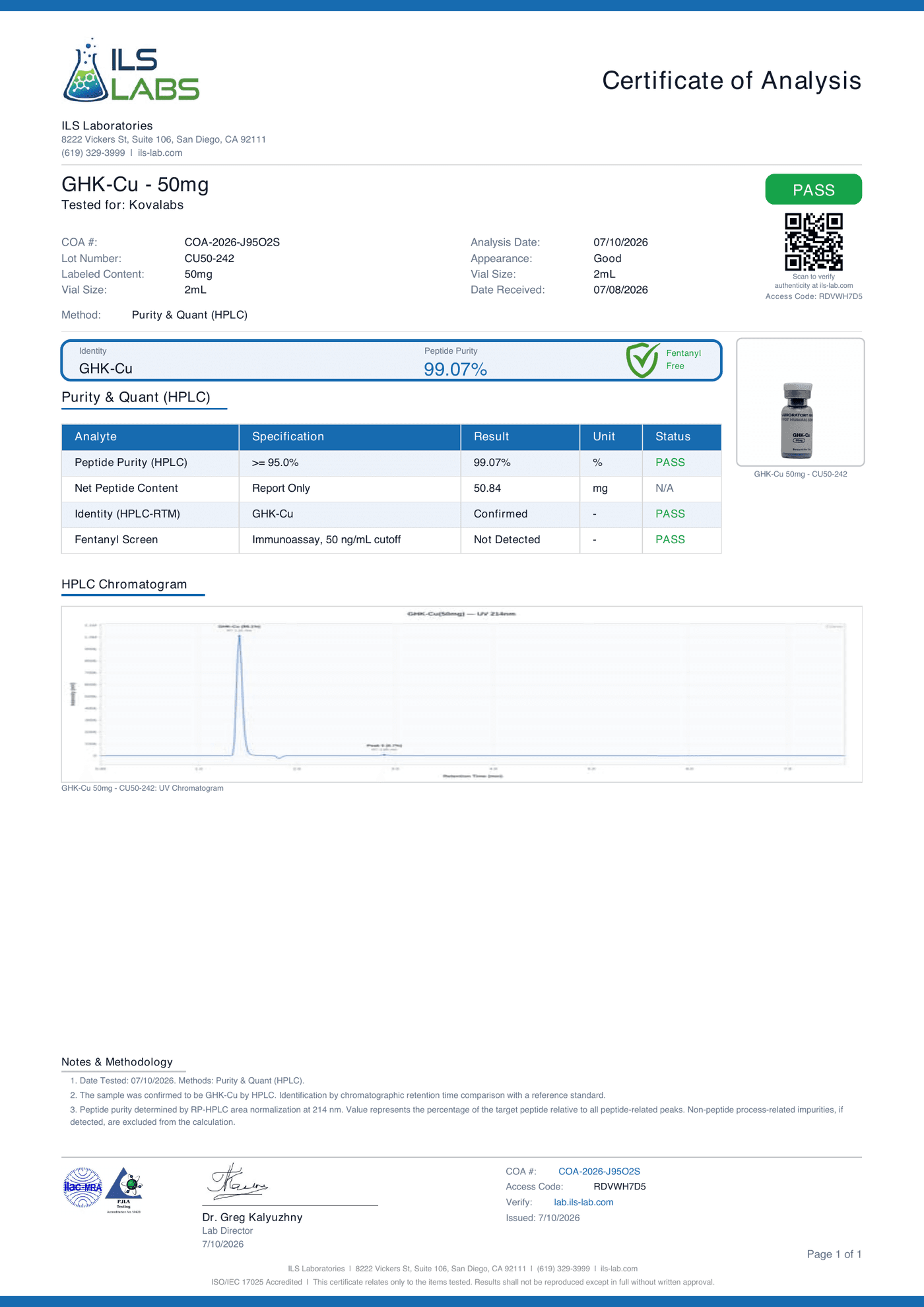
Note what the certificate does not do. It certifies the chemistry and the contamination status of a research reagent. It says nothing about fitness or safety for use in any person or animal, because that is not what a reagent certificate is for.
How is net peptide content actually measured?
This is where the field gets genuinely awkward, and it is worth being straight about it. Quantifying how much peptide is in a sample is harder than it sounds, and different analytical approaches do not always agree. A 2019 survey in the Journal of Pharmaceutical and Biomedical Analysis compared peptide quantification methods using oxytocin as a case study and examined how reproducibly those methods return the same answer (study design only; no effect of any compound is asserted). The short version: the number depends on the method, which is precisely why a stated net content is only as good as the lab that produced it and the reference it was measured against.
For the research buyer the practical upshot is unfussy. A purity percentage on its own is a partial picture. A purity percentage sitting next to a measured net peptide content, from an accredited lab, per fill, with the chromatogram shown, is a complete one. When two certificates both say 99 percent and only one prints net content, you are no longer comparing like with like, and now you know why.
- Li C, Bhavaraju S, Thibeault MP, et al. "Survey of peptide quantification methods and comparison of their reproducibility: A case study using oxytocin." Journal of Pharmaceutical and Biomedical Analysis, 2019. PMID 30640042. DOI: 10.1016/j.jpba.2018.12.028
- PubChem Compound Summary, CID 71587328 (GHK-Cu, copper tripeptide-1). pubchem.ncbi.nlm.nih.gov/compound/71587328
- Kovalabs GHK-Cu Certificate of Analysis, lot CU50-242 (ILS Laboratories, ISO/IEC 17025). images.kovalabs.co.uk/blog/coa/ghk-cu-cu50-242.pdf
Publication titles are the original authors' own titles, not statements or claims by Kovalabs.
What is net peptide content in simple terms?
It is the fraction of a vial's total dry mass that is actually peptide. The rest is bound counterion (TFA or acetate) and residual water. It answers how much peptide is in the vial, which purity alone does not.
Is 99 percent purity the same as 99 percent peptide?
No. Purity by RP-HPLC is a relative measure comparing the target peak to other peptide species. Net peptide content is an absolute mass fraction that also accounts for counterion and water. A powder can be 99 percent pure and still be well under 99 percent peptide by weight.
What is the difference between HPLC purity and net peptide content?
Purity says how clean the peptide is relative to related impurities, measured by area normalisation at 214 nm. Net peptide content says how much peptide the vial holds by mass. They answer different questions and both belong on a complete certificate.
Why does a 5 mg and a 10 mg vial need separate testing?
Net peptide content is measured per fill, and fills differ. Different strengths are filled from separately weighed material, so the peptide-to-salt-to-water ratio can drift between them. Every strength gets its own measurement rather than an assumed value.
Where can I see a real net peptide content result?
The GHK-Cu certificate for lot CU50-242 records 99.07 percent purity by RP-HPLC and a net peptide content of 50.84 mg against a 50 mg label. Certificates are published on the certificate of analysis page and each carries a QR code that verifies at the testing lab's own portal.
Does a good certificate mean the material is safe to use?
No. A certificate documents the chemistry and contamination status of a research reagent. It makes no statement about fitness or safety for use in a person or animal. Kovalabs peptides are supplied for research use only.
Research use only
Research use only. All Kovalabs peptides are laboratory reference materials sold strictly for in-vitro research and analytical work. They are not medicines, hold no marketing authorisation, and are not for human or animal consumption, ingestion, injection, or topical application. A certificate of analysis documents chemistry and contamination status, not fitness for use in any living organism. See our research disclaimer for the full terms.