Free 24-hour delivery over £75 · Same-day dispatchOrder before 3pm - same-day dispatch · Free 24-hour delivery over £75
What is the GLOW stack (GHK-Cu, BPC-157, TB-500)?
· 8 min read
Three compounds turn up together so often that the research-peptide forums gave the grouping a nickname: GLOW. It is not an acronym that decodes to anything. GLOW is market shorthand for a grouping of three separate reference compounds - GHK-Cu, BPC-157 and TB-500 - co-listed because their published studies sit in adjacent corners of the tissue-and-matrix literature, not because anyone has run them as one thing. What follows is a research-context read of what each compound actually is, with verified identifiers, and how the grouping differs from KLOW. Everything here describes what published studies have investigated, never any human use. The compounds are supplied by Kovalabs strictly as separate research reagents; see our research disclaimer for the full position.
What is the GLOW stack?
Read the name as a catalogue handle, nothing more. The GLOW stack that Kovalabs supplies comes either as one co-formulated 70mg lyophilised vial or as three single-compound vials; either way it is three distinct compounds, not a single peptide. The GLOW peptide stack is bundled so a laboratory can source the trio in one order, and each constituent links out to its own product page for full chemistry and per-batch documentation. The "GHK glow" association most people half-remember traces to the first compound, GHK-Cu, whose reconstituted solution is a vivid copper blue. The letters are constituent-derived; they are not a description of any result.
What is in the GLOW stack?
Three compounds, three masses, three sets of identifiers. This is the ghk-cu bpc-157 tb-500 grouping people search for, and the useful thing about naming it by identifiers rather than by nickname is that identifiers are the part a certificate of analysis can actually check.
| Compound | What it is | Formula | Mol. weight | CAS | PubChem CID |
|---|---|---|---|---|---|
| GHK-Cu | Copper(II) complex of the Gly-His-Lys tripeptide | C14H23CuN6O4+ | 402.92 g/mol | 89030-95-5 | 71587328 |
| BPC-157 | 15-residue pentadecapeptide, gastric protein fragment | C62H98N16O22 | 1419.5 g/mol | 137525-51-0 | 9941957 |
| TB-500 | Full-length thymosin beta-4 (TB-4), 43 residues, N-terminally acetylated | C212H350N56O78S | 4963.4 g/mol | 77591-33-4 | 16132341 |
The vials as supplied are GHK-Cu at a 50 mg label, BPC-157 at 10 mg and TB-500 at 10 mg. Those are fill masses printed on the label, not amounts directed at anything living.
How does each compound work, at the receptor level?
Here is the part the nickname hides: the three do not share a mechanism, a receptor or a target. Group them by pharmacology and they land in three different boxes, not one.
- GHK-Cu. A copper(II) coordination complex of the tripeptide glycyl-L-histidyl-L-lysine. Free GHK is a separate database record (CID 73587, C14H24N6O4, MW 340.38), which is worth knowing because the copper complex and the bare tripeptide are catalogued apart. The science is coordination chemistry - how the Gly-His-Lys backbone binds a single copper ion - and the published work references it in collagen and extracellular-matrix remodelling, copper-dependent cellular processes and gene-expression profiling, in cell and animal models. Study design only; no effect of the compound is asserted.
- BPC-157. A synthetic 15-amino-acid sequence corresponding to a fragment of a protein identified in gastric juice, carrying no cysteine and no disulfide bond. Its literature is overwhelmingly in-vitro and rodent, examined around nitric-oxide-system and angiogenic signalling and tissue remodelling. No defined receptor is established. Study design only; no effect of the compound is asserted.
- TB-500. Full-length synthetic thymosin beta-4 (TB-4): the complete 43-residue, N-terminally acetylated peptide, about 4,963 g/mol. Some suppliers use the TB-500 name for a seven-residue fragment instead, which is a different molecule. Thymosin beta-4 is examined in laboratory models of actin sequestration and cell migration. Study design only; no effect of the compound is asserted.
Copper coordination, angiogenic-system signalling and actin regulation are three different mechanisms in three different vials. That distinction matters for the next question.
Why are these three grouped together?
The tempting read is that GLOW is a recovery-and-skin protocol, three compounds chosen to converge on one glow-shaped outcome. That is not what the grouping is. Each of GHK-Cu, BPC-157 and TB-500 has its own separate body of non-clinical literature, and as the mechanisms above show, those bodies of work do not converge on a shared receptor or a shared endpoint. The three are offered together purely as a sourcing convenience, so a laboratory can obtain three distinct reference standards in a single order. The grouping is not a combined preparation, and no combined effect, interaction or synergy is claimed or implied.
GLOW vs KLOW: what is the difference?
A difference of composition, and nothing else.
| Feature | GLOW | KLOW |
|---|---|---|
| Compounds | GHK-Cu, BPC-157, TB-500 | GHK-Cu, BPC-157, TB-500 plus KPV |
| Number of vials | 3 | 4 |
| Relationship | The base trio | GLOW plus KPV |
| Format | One co-formulated vial or three separate vials | One co-formulated vial or three separate vials |
So KLOW is the same trio with KPV added as a fourth vial: KLOW is GLOW plus KPV. Neither name describes a result; both are search shorthand for which reference compounds are in the box. Vendors define both slightly differently, so read the label, not the letters.
How strong is the evidence, really?
Three tiers, weakest at the bottom, and the honest answer gets thinner as you descend.
Tier one, settled: identity. All three compounds have unambiguous, cross-checked public-database identities - formula, mass, CAS and CID that agree - and identity is exactly what a certificate can verify in a vial.
Tier two, softer: mechanism. Each compound has real in-vitro and animal literature (copper coordination, angiogenic and nitric-oxide-system signalling, actin regulation), but the work is scattered across cell lines and rodents, the mechanisms are distinct rather than convergent, and none of it was measured in a human.
Tier three, thin: human data. Controlled human trial evidence for the individual compounds is thin to absent, and for the three together as a combination there is no registered clinical trial at all. None of the three is a licensed medicine. The leap from an in-vitro or animal observation to a human result is not supported, and neither is any expected-outcome leap borrowed from an approved medicine. GLOW has not been shown to produce any defined outcome in anything living.
How is the quality of each vial verified?
Verify, do not trust. A vial that says GHK-Cu is not the same as a vial that is GHK-Cu, and a three-vial grouping simply triples the number of identities that have to be confirmed rather than assumed. Every Kovalabs batch, and every variant - because net peptide content is measured per fill rather than assumed from one strength - is tested at ILS Laboratories, an ISO/IEC 17025 accredited lab in San Diego. Each report carries purity by RP-HPLC (area normalisation at 214 nm) with the actual chromatogram shown, identity by HPLC retention-time matching against a reference standard, the measured net peptide content, and an immunoassay fentanyl screen at a 50 ng/mL cutoff. The certificate is addressed "Tested for Kovalabs", and a QR code verifies it at the lab's own portal.
The co-formulated vial is released on its own blend certificate (lot GLOW-288); where the compounds are supplied as separate vials, each is released on its own batch, so check the certificate for each. A worked example: the GHK-Cu lot CU50-242 certificate reports 99.07% purity, a net peptide content of 50.84 mg against a 50 mg label, and fentanyl not detected.
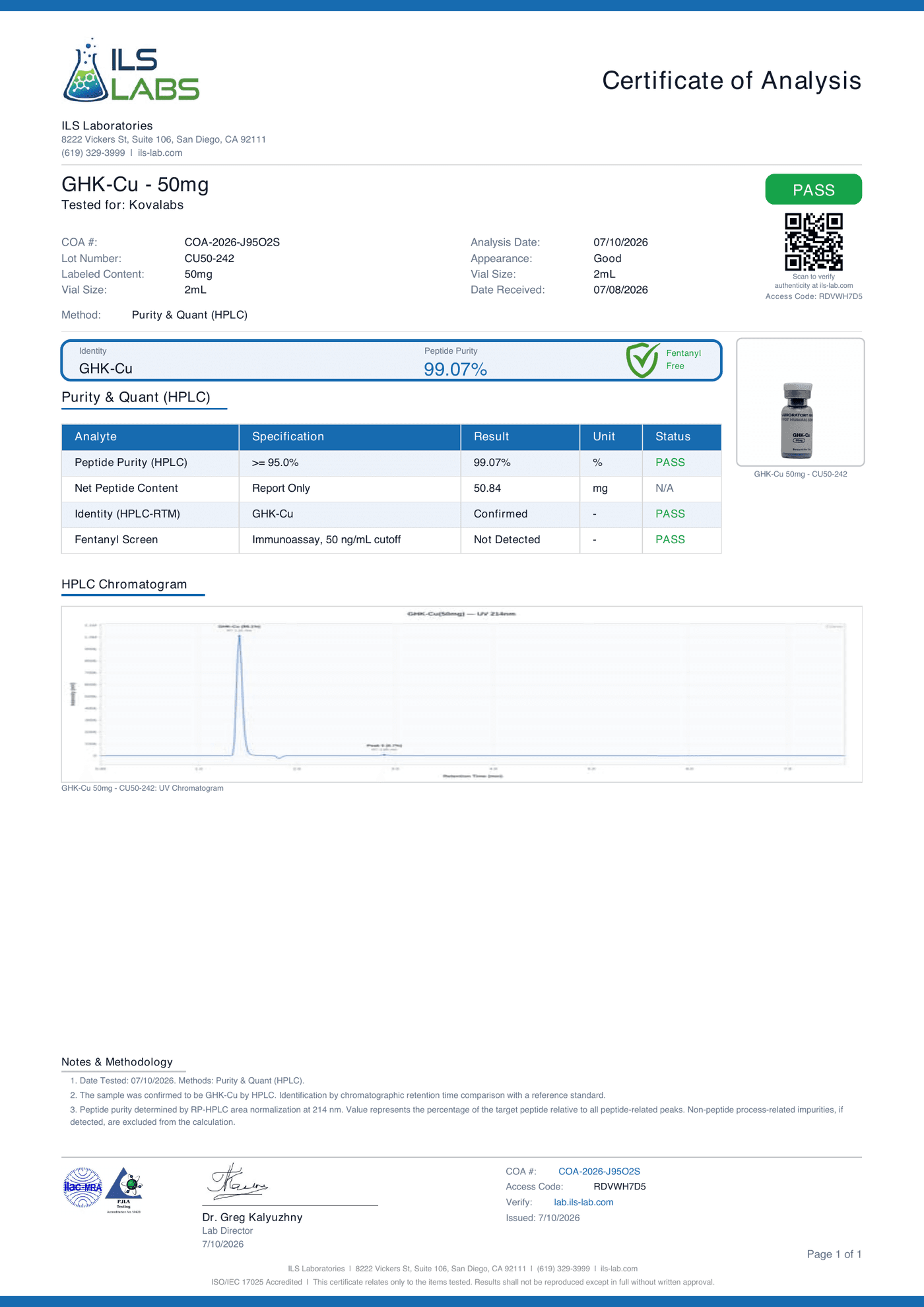
You can verify this lot at the lab's own portal or open the full certificate PDF. Current documents live on the certificate of analysis page. QC certifies the chemistry and contamination status of a research reagent; it says nothing about fitness or safety for use in any person.
How are the vials handled in the laboratory?
Three reagents, handled by the same general bench practice for lyophilised research peptides, anchored to peer-reviewed handling guidance. Laboratories reconstitute lyophilised reference peptides with a suitable solvent such as bacteriostatic water, following their own standard operating procedures. The sealed vials are typically stored at -20C, kept dry and out of light, with any reconstituted material held at 2-8C. Our reconstitution guide sets out the general workflow. This is framed for laboratory use only and is not a preparation method for any use in humans or animals.
Sources and identifiers
Publication titles below are the original authors' own titles, not statements or claims by Kovalabs. Identifiers were confirmed against the public databases at the time of writing; verify against the batch documentation you hold.
- PubChem CID 71587328 - GHK-Cu (copper tripeptide-1), C14H23CuN6O4+, MW 402.92, CAS 89030-95-5
- PubChem CID 73587 - free GHK tripeptide (glycyl-L-histidyl-L-lysine), C14H24N6O4, MW 340.38
- PubChem CID 9941957 - BPC-157 pentadecapeptide, C62H98N16O22, CAS 137525-51-0
- PubChem CID 16132341 - TB-500 / full-length thymosin beta-4, C212H350N56O78S, CAS 77591-33-4
What is the GLOW stack?
It is a grouping of three reference compounds for non-clinical laboratory research: GHK-Cu (50 mg), BPC-157 (10 mg) and TB-500 (10 mg). Kovalabs offers it either as one co-formulated 70mg lyophilised vial or as three separate single-compound vials. It is not a single peptide. For laboratory research use only; not for human or veterinary use.
What is in the GLOW stack?
The ghk-cu bpc-157 tb-500 grouping: GHK-Cu (copper tripeptide-1, CID 71587328), BPC-157 (pentadecapeptide, CID 9941957) and TB-500 (full-length thymosin beta-4, CID 16132341), as one co-formulated vial or as separate vials. Each constituent links to its own product page for full chemistry and per-batch documentation.
What is the difference between GLOW and KLOW?
Composition only. GLOW is the three-compound grouping of GHK-Cu, BPC-157 and TB-500. KLOW is that same trio with KPV added as a fourth vial, so KLOW is GLOW plus KPV. Neither name describes a result; both are search shorthand for which reference compounds are in the box.
Do the three compounds in the glow peptide stack work the same way?
No. Grouped by pharmacology they are distinct: GHK-Cu is a copper(II) coordination complex, BPC-157 has no defined receptor and appears in nitric-oxide-system and angiogenic signalling work, and TB-500 is full-length thymosin beta-4, an actin-sequestering peptide. They do not share a receptor or a target, and none of this describes an effect in humans.
Is a combined effect claimed for the GLOW stack?
No. The constituents are grouped only as a sourcing convenience of reference materials. No combined effect, interaction or synergy is claimed or implied. No human or veterinary use is intended.
Does each vial come with its own certificate of analysis?
Yes. Every batch is tested at an ISO/IEC 17025 accredited lab, with purity by RP-HPLC, identity by retention-time matching, measured net peptide content and a fentanyl screen. The co-formulated vial has its own blend certificate (lot GLOW-288 lists GHK-Cu, BPC-157 and TB-4 content); where the compounds are supplied as separate vials, each is a separate batch with its own certificate. Current documents are on the Certificates of Analysis page.
Research use only
For laboratory research use only. The GLOW stack is three reference compounds, supplied as one co-formulated vial or as three vials; it is not a medicine, food, supplement or cosmetic, holds no marketing authorisation, and is not for human or veterinary use. Nothing here is a benefit, outcome, dosing or safety claim, and no combined effect is claimed or implied. Handling is confined to a controlled research setting. See the research disclaimer for the full terms of supply.