Free 24-hour delivery over £75 · Same-day dispatchOrder before 3pm - same-day dispatch · Free 24-hour delivery over £75
NAD vs NMN: what is the actual difference between the coenzyme and its precursor?
· 9 min read
Type the two acronyms into a search bar and half the results treat them as the same thing sold under two labels, or as rival versions of one product. They are neither. NAD+ and NMN are two different molecules that happen to live one step apart on the same metabolic road: one is the coenzyme a cell actually spends, the other is a smaller building block that gets turned into it. Getting the chemistry straight is the whole point of this page, and it is easier than the marketing makes it look. Everything below describes molecular identity and published biochemistry, not human use. Kovalabs supplies NAD+ strictly as a research reagent; see the NAD+ product listing for supply details. NMN is not a Kovalabs product and is named here only as a point of chemical comparison.
What is NAD+, and what is NMN?
NAD+ (nicotinamide adenine dinucleotide, oxidised form) is a small-molecule dinucleotide coenzyme. It is built from two nucleotides joined at their phosphate groups: an adenosine monophosphate moiety bridged through a pyrophosphate to a nicotinamide mononucleotide. Its canonical record is PubChem CID 5892, CAS 53-84-9, molecular formula C21H27N7O14P2, molecular weight 663.43 g/mol, and InChIKey BAWFJGJZGIEFAR-NNYOXOHSSA-N. It is not a peptide, and it is not a hormone.
NMN (nicotinamide mononucleotide) is one of those two halves on its own, before the adenosine nucleotide gets bolted on. It resolves to a separate PubChem record, CID 14180, molecular formula C11H15N2O8P, molecular weight 334.22 g/mol. Roughly half the mass, one nucleotide instead of two, and a distinct identifier. So the honest one-line answer to the difference between NAD and NMN is structural: NMN is a mononucleotide precursor, NAD+ is the finished dinucleotide coenzyme. Nicotinamide riboside (NR) is a third molecule in the same family, a precursor that feeds in one step earlier still.
| Property | NAD+ | NMN |
|---|---|---|
| Type of molecule | Dinucleotide coenzyme | Mononucleotide precursor |
| Metabolic position | The active cofactor cells spend | One step upstream; feeds the salvage pathway |
| Molecular formula | C21H27N7O14P2 | C11H15N2O8P |
| Molecular weight | 663.43 g/mol | 334.22 g/mol |
| PubChem CID | 5892 | 14180 |
Precursor or coenzyme: which one does the metabolic work?
This is where the conflation actually matters. A coenzyme is a molecule an enzyme uses to get a reaction done; a precursor is raw material the cell converts into that coenzyme. NAD+ is the coenzyme. In the published biochemistry it plays two mechanistically distinct roles, and running them together is a common shortcut in lay coverage. First it is a redox cofactor, shuttling electrons in and out of central metabolism. Second it is a consumed co-substrate for NAD+-cleaving enzyme families such as the sirtuins, the PARPs and CD38, which use it up rather than recycle it. A narrative review by Braidy and colleagues maps both roles alongside the salvage pathway that keeps replenishing the intracellular pool.
NMN sits inside that salvage pathway. The enzyme NMNAT joins NMN to an adenylyl group to make NAD+, which is why NMN and NR get described as precursors: they are substrates the cell processes into the coenzyme, not the coenzyme itself. A review by Colombo and colleagues, framed in a colorectal-cancer context, surveys this substrate relationship and NAMPT as the rate-limiting salvage enzyme. So the relationship is directional, not interchangeable. NMN feeds NAD+; NAD+ is what the enzymes then spend. Both citations are narrative reviews of enzyme biochemistry; no human-outcome endpoint is asserted.
NAD+ vs NADH: what do the plus sign and the extra H mean?
A second point of confusion is NADH, and here the answer is genuinely simple. NAD+ and NADH are the same coenzyme in two oxidation states. The plus sign marks the oxidised form, which carries a net positive charge on its nicotinamide ring. NADH is the reduced form: it has accepted a hydride, which is why its formula is C21H29N7O14P2 (PubChem CID 439153) rather than C21H27N7O14P2. Two more hydrogens, a shade heavier at 665.4 g/mol, no positive charge on the ring. The two interconvert continuously as electrons are passed around, forming the NAD+/NADH redox couple that sits at the centre of cellular energy metabolism.
Is NADH a coenzyme? Yes. It is simply the electron-loaded state of the same coenzyme, so NAD+ and NADH are best thought of as one coenzyme couple rather than two separate compounds. That is a different kind of distinction from NAD+ versus NMN: NAD+ vs NADH is one molecule in two redox states, whereas NAD+ vs NMN is two molecules a biosynthetic step apart. The oxidation-state detail matters at the bench, because an assay reading for the charged NAD+ ring is not reading the same species as NADH.
Does topping up NMN reverse ageing?
Here is the claim the marketing wants you to make. Intracellular NAD+ availability declines with age in various cell and animal models; NMN and NR are precursors that raise NAD+ in those models; therefore supplying a precursor rolls back the clock. It is a tidy story, and it is exactly the kind of tidy story that outruns its evidence.
Two links in that chain are doing unearned work. The first is the leap from a measured biochemical fact (a coenzyme pool changes) to a human outcome (ageing is reversed): a pool concentration is not a lifespan, and no such outcome has been established in people. The second is the quiet swap of the molecule: much of the human trial literature studied precursors, chiefly nicotinamide riboside, rather than NAD+ itself dosed in humans, so a headline about NAD+ ageing is often standing on data about a different compound. Kovalabs makes no longevity, age-reversal or any other human-outcome claim for NAD+, NMN or NR. The interesting chemistry is real; the finish line the copywriters draw is not in the data.
How strong is the evidence, really?
Split the record into three tiers and the confidence drops sharply as you go down.
Settled chemistry. The molecular identities are not in dispute. NAD+, NMN, NR and NADH are well-characterised compounds with public identifiers, defined structures and decades of enzymology behind the salvage and de novo biosynthetic pathways. That NMN is a precursor and NAD+ is the coenzyme it becomes is textbook biochemistry. This tier is solid.
Softer cell and animal work. The observation that NAD+ availability shifts with age, and that precursors raise measured NAD+ in laboratory models, comes largely from cell culture and rodent studies. These are model systems, informative about mechanism and pathway flux, but not a substitute for controlled human data. Treat them as hypotheses about biochemistry, not conclusions about people.
The thin human record. The controlled human trials that exist mostly investigated precursors rather than NAD+ itself, and they are cited here for study design only, with no result reproduced. Conze, Brenner and Kruger (Sci Rep, 2019; PMID 31278280) ran an 8-week randomised, double-blind, placebo-controlled trial of nicotinamide riboside chloride; pre-specified endpoints named only: whole-blood NAD+ concentration, the NAD+ metabolome and tolerability. Study design only; no effect of the compound is asserted. Martens and colleagues (Nat Commun, 2018; PMID 29599478) similarly ran a randomised, double-blind, placebo-controlled crossover study of nicotinamide riboside; endpoints named only: the NAD+ metabolome, blood pressure and arterial stiffness. Study design only; no effect of the compound is asserted. The point is not that no research exists. It is that the evidence thins exactly where the marketing shouts loudest, and none of it licenses an approved-medicine or reverse-ageing conclusion for any of these molecules.
How do you know the vial holds NAD+ and not something else?
Because NAD+, NMN and NR are so routinely conflated in copy, identity is exactly the thing worth verifying rather than trusting on a label. A dinucleotide and a mononucleotide are different masses and different retention behaviour, so an analytical report can tell them apart where a printed sticker cannot. Every Kovalabs batch is tested at ILS Laboratories in San Diego, an ISO/IEC 17025 accredited lab, and each report carries purity by RP-HPLC (area normalisation at 214 nm) with the actual chromatogram shown, identity by HPLC retention-time matching against a reference standard, and a fentanyl screen by immunoassay at a 50 ng/mL cutoff. The report is addressed to Kovalabs as chain of custody, and a QR code verifies it at the lab's own portal. You can request the certificate of analysis for a batch before deciding anything.
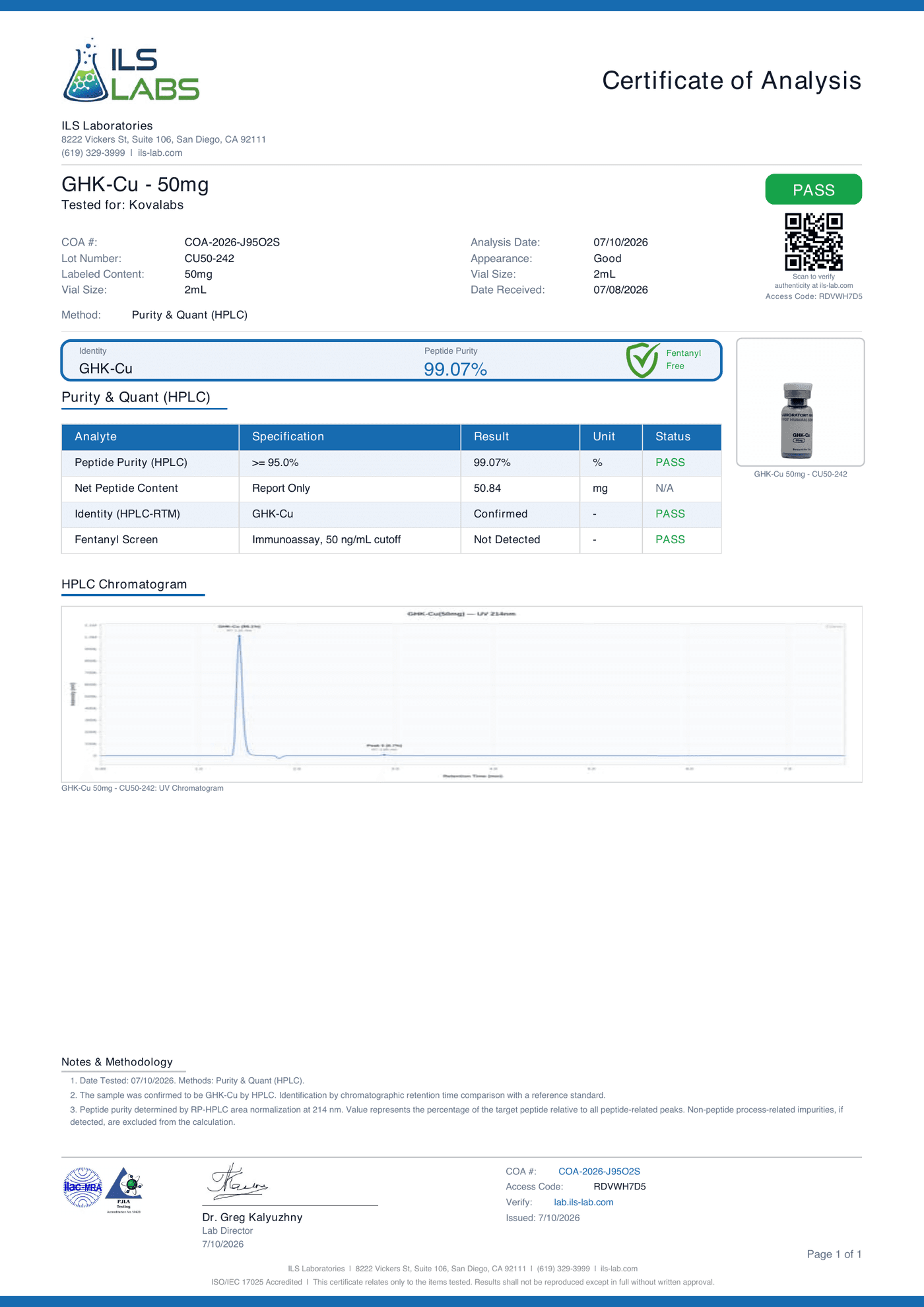
If NAD+ is being reconstituted for laboratory work, the reconstitution guidance covers handling of a lyophilised research reagent. QC certifies the chemistry and contamination status of a reagent; it says nothing about fitness or safety for use in any person or animal.
Researchers comparing distinct cellular-chemistry tools sometimes also look at glutathione, a tripeptide thiol whose redox chemistry works by a completely different mechanism to a dinucleotide cofactor, or at MOTS-c, a mitochondrial-derived peptide. Both are mechanistically unrelated to NAD+ despite sitting in the same broad research area.
Sources
- PubChem Compound (NCBI) - CID 5892, NAD+ (properties, synonyms and CAS 53-84-9)
- PubChem Compound (NCBI) - CID 14180, nicotinamide mononucleotide (NMN)
- PubChem Compound (NCBI) - CID 439153, NADH (reduced form)
- Braidy N, et al. Role of Nicotinamide Adenine Dinucleotide and Related Precursors as Therapeutic Targets for Age-Related Degenerative Diseases: Rationale, Biochemistry, Pharmacokinetics, and Outcomes. Antioxid Redox Signal. 2019;30(2):251-294 (PMID 29634344)
- Colombo G, et al. Insight Into Nicotinamide Adenine Dinucleotide Homeostasis as a Targetable Metabolic Pathway in Colorectal Cancer. Front Pharmacol. 2021;12:758320 (PMID 34880756)
- Conze D, Brenner C, Kruger CL. Safety and Metabolism of Long-term Administration of NIAGEN (Nicotinamide Riboside Chloride) in a Randomized, Double-Blind, Placebo-controlled Clinical Trial of Healthy Overweight Adults. Sci Rep. 2019;9(1):9772 (PMID 31278280)
- Martens CR, et al. Chronic nicotinamide riboside supplementation is well-tolerated and elevates NAD+ in healthy middle-aged and older adults. Nat Commun. 2018;9(1):1286 (PMID 29599478)
Publication titles are the original authors' own titles, not statements or claims by Kovalabs.
What is the difference between NAD and NMN?
NAD+ (nicotinamide adenine dinucleotide) is a dinucleotide coenzyme; NMN (nicotinamide mononucleotide) is a smaller precursor molecule that the cell converts into NAD+ via the salvage pathway. They are distinct compounds with different identifiers: NAD+ is CID 5892 and CAS 53-84-9, NMN is CID 14180. One is the finished cofactor, the other is upstream raw material.
Is NAD+ the same as NMN?
No. NMN is roughly half the mass of NAD+ (334.22 versus 663.43 g/mol) and carries one nucleotide rather than two. NMN is a biosynthetic precursor; NAD+ is the coenzyme it becomes once an adenosine nucleotide is added. They are not interchangeable and are not two versions of one product.
What is the difference between NAD and NADH?
NAD+ and NADH are the same coenzyme in two oxidation states. NAD+ is the oxidised form, carrying a positive charge on its nicotinamide ring (C21H27N7O14P2). NADH is the reduced form, having gained a hydride (C21H29N7O14P2, CID 439153). They interconvert as the NAD+/NADH redox couple.
Is NADH a coenzyme?
Yes. NADH is the electron-loaded, reduced state of the NAD+ coenzyme, so it is best treated as one coenzyme couple with NAD+ rather than a separate compound. Research using NAD+ frequently references this NAD+/NADH cycling.
Is NMN a Kovalabs product?
No. Kovalabs supplies NAD+ as a research reagent, not NMN. NMN is named on this page only as a point of chemical comparison to explain the precursor-versus-coenzyme relationship.
Does NMN or NAD+ have proven age-reversal effects in humans?
No such outcome has been established in people, and Kovalabs makes no age-reversal or longevity claim for either molecule. The observation that NAD+ availability changes with age comes largely from cell and animal models, and much of the human trial literature studied precursors such as nicotinamide riboside rather than NAD+ itself. These are supplied as research chemicals only, not medicines.
Research use only
Research use only. NAD+ is supplied by Kovalabs strictly as a research reagent for laboratory and analytical use. It is not a medicine, supplement or food, and is not for human or veterinary use. NMN and NR are named here only for chemical comparison and are not sold by Kovalabs. Nothing on this page is a claim of any effect, benefit or outcome in any person or animal. See our research disclaimer for full terms.