
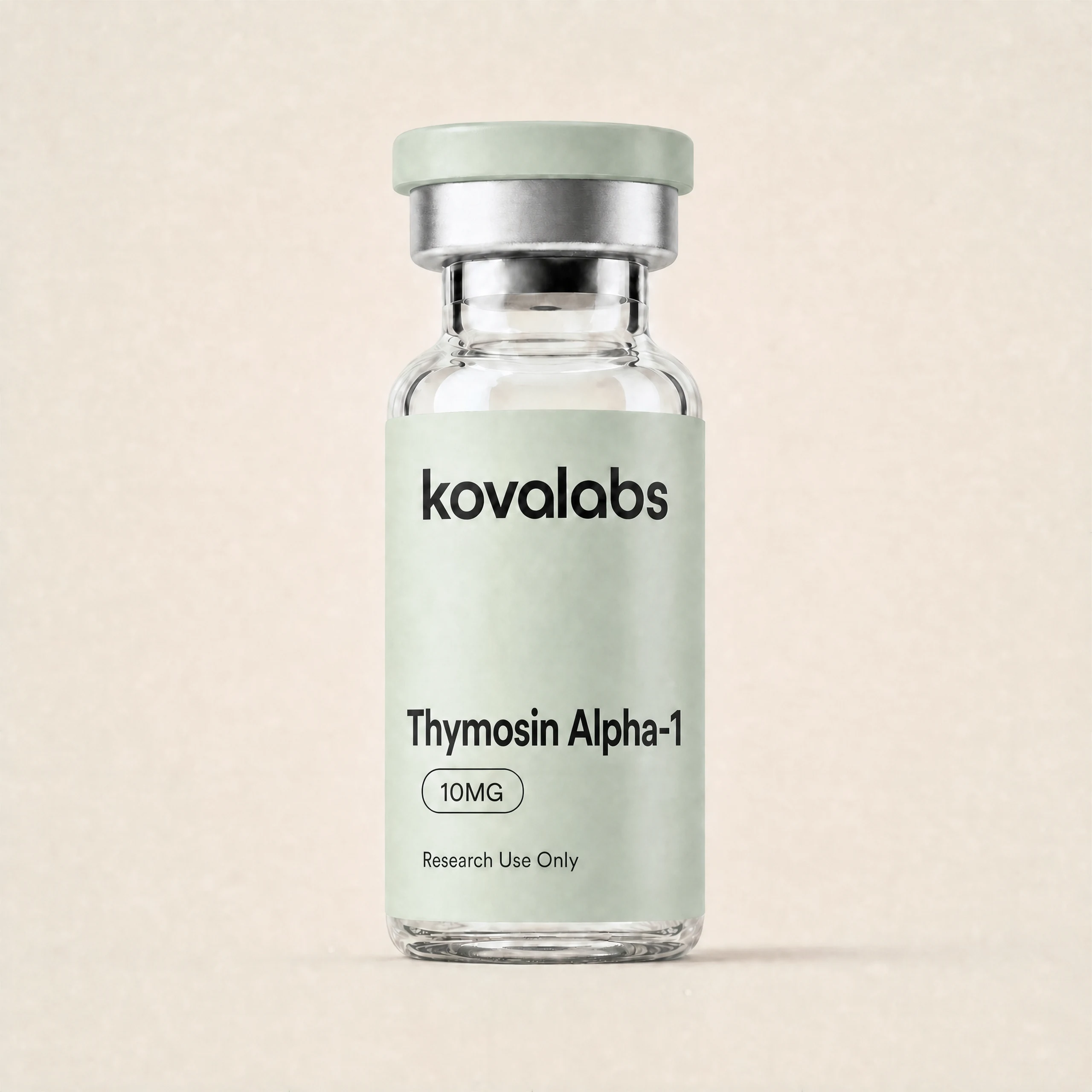
Thymosin Alpha-1 10mg
TA10-303
99.13%
Peptide purity
- Purity (HPLC)
- 99.13%
- Net peptide content
- 10.58 mg
- Identity (HPLC-RTM)
- Thymosin Alpha-1
- Fentanyl screen
- Not Detected
ILS LabsTested 18 Aug 2026
Research use only
Kovalabs supplies research-grade peptides to qualified researchers for laboratory use only. They are not medicines, are not for human or animal consumption, and are supplied with no dosing or medical guidance.
You must be 18 or over and a qualified person purchasing solely for scientific research.
Selecting ‘I agree’ confirms the above and your acceptance of our Research Disclaimer and Terms of Sale.
Manufactured for laboratory research. Not for human or veterinary use. Read full disclaimer →
Thymosin Alpha-1 is a synthetic 28-amino-acid N-terminally acetylated peptide studied in research into Toll-like-receptor signalling and dendritic-cell activation in experimental models.
Thymosin Alpha-1 is a synthetic 28-amino-acid peptide, acetylated at the N-terminus, with the sequence SDAAVDTSSEITTKDLKEKKEVVEEAEN. Its molecular formula is C129H215N33O55, molecular weight 3108.3 g/mol and CAS number 62304-98-7. Kovalabs supplies it lyophilised as a research reference compound for laboratory use only.
The N-terminal acetyl group is part of the defined structure rather than an optional modification, and is one of the features an identity assay confirms. At 28 residues it is a substantially larger molecule than the short signalling peptides elsewhere in the catalogue, which is relevant to handling and to how it behaves on an HPLC trace. It is supplied as a reference material, not as a medicine or supplement.
Thymosin Alpha-1 is not a controlled drug under the Misuse of Drugs Act 1971 and is not scheduled. It is supplied in the UK strictly as a research chemical for laboratory use only. It is not a licensed medicine in the UK, holds no UK marketing authorisation, and cannot be sold or supplied for human or veterinary consumption. It must not be used as a medicine. The buyer is responsible for lawful, compliant handling under their own jurisdiction. See our research disclaimer.
Each batch is released after independent testing. Purity is assessed by HPLC at 99% or greater, and identity is confirmed against the expected mass for C129H215N33O55 (CAS 62304-98-7, PubChem CID 16130571). A batch-specific Certificate of Analysis accompanies the material; current documents are published on our CoA page. For a peptide of this length, independent confirmation matters more rather than less: truncated or deletion sequences are the common failure mode in longer chains, and only an identity assay against the expected mass will surface them.
The published literature uses Thymosin Alpha-1 as a tool compound to probe innate-immune signalling in cell-based systems: activation of dendritic cells, engagement of Toll-like receptor pathways including a TLR9 / MyD88 / IRF7-dependent route described in murine models, and complement-receptor-mediated phagocytosis in human monocytes in vitro. People searching for Thymosin Alpha-1 benefits or effects should note that none of this establishes any benefit, effect or outcome in humans; it is not a licensed medicine in the UK and no human or veterinary application is intended or implied.
The shared word "thymosin" is the main source of confusion between them, and they are not variants of one compound. Thymosin Alpha-1 is a 28-residue acetylated peptide studied in innate-immune signalling literature. TB-500 is a short synthetic fragment associated with thymosin beta-4, a structurally unrelated protein studied in tissue-repair and cell-migration research; the two belong to different families and act through different mechanisms. KPV is a third distinct molecule, a tripeptide studied in inflammatory-pathway research. These are identity comparisons only, not protocols and not any guidance for use in a body.
Thymosin Alpha-1 is supplied as a white to off-white lyophilised solid for reconstitution at the bench with a research solvent such as bacteriostatic water. Store lyophilised material at -20C, dry and protected from light; hold reconstituted material at 2-8C. Sold per vial as a product specification, despatched from the UK. For laboratory research use only; not for human or veterinary use.
Specifications for this product have not been published yet. Get in touch if you need the full data sheet for laboratory use.
Thymosin Alpha-1 10mg
TA10-303
99.13%
Peptide purity
Pairs with this
Great experience once again
Great product range! My order arrived next day as stated. I’ll be a returning customer for sure. Thanks guys
Ordered yesterday, arrived today. Impressed with quality will update.