Free 24-hour delivery over £75 · Same-day dispatchOrder before 2pm - same-day dispatch · Free 24-hour delivery over £75
What is a fentanyl screen on a research peptide COA, and why does it matter?
· 5 min read
Fentanyl on a peptide certificate of analysis looks, on first read, like a filing error. One is a synthetic opioid; the other is a lyophilised research reagent. Put them on the same document and the instinct is to assume someone crossed the wires. Nobody did. A fentanyl screen is one of the quieter lines on a Kovalabs fentanyl-checked report, and it earns its place for a reason worth spelling out.
Everything below concerns the contamination status of a research reagent, not its fitness for use in any person or animal. Kovalabs peptides are supplied for laboratory research use only.
What is a fentanyl screen on a peptide COA?
It is a targeted contaminant test. On a Kovalabs certificate of analysis, the fentanyl screen is an immunoassay run against a 50 ng/mL cutoff, reported as a plain Detected or Not Detected. It sits alongside the analytical lines that describe the peptide itself: purity by RP-HPLC (area normalization at 214 nm), identity by HPLC-RTM (retention-time matching against a reference standard), and net peptide content. The purity and identity lines tell you what the material is and how clean it is. The fentanyl line answers a different question entirely: whether one specific unwanted molecule is present above a defined threshold. If you have searched "peptide coa fentanyl" and wondered why the two words sit together, that is the whole of it.
| Method | Immunoassay |
|---|---|
| Reporting threshold | 50 ng/mL cutoff |
| Result format | Detected / Not Detected |
| Scope | Every batch, and every variant or strength |
| Testing lab | ILS Laboratories, San Diego, an ISO/IEC 17025 accredited laboratory |
Why would a research peptide need a fentanyl screen at all?
The honest answer is that you cannot certify the absence of something you never looked for. Peptides are made and handled in facilities that share equipment, solvents and supply chains, and the wider chemical supply chain is not sealed off from controlled substances. Trace opioid contamination in poorly synthesised or carelessly handled material is a documented risk across the grey market, not a hypothetical. A fentanyl screen does not claim the risk is common; it removes the assumption that the risk is zero. That distinction is the entire point of testing rather than trusting.
This is also where the QC gap in the market shows itself. Most research-peptide COAs never carry this line. A certificate can print an impressive purity percentage and say nothing at all about opioid contamination, because a purity figure and a contaminant screen measure different things. Area-normalized HPLC purity describes the proportion of peptide in the peptide-related material; it is not designed to flag a trace adulterant. If a report is silent on fentanyl, the silence is not evidence of a clean result. It is evidence that nobody asked the question.
Are research peptides tested for fentanyl as standard?
As a rule, no. Peptide fentanyl testing is an extra assay, at an extra cost, run at a lab that offers it, and the market default is to skip it. So when a researcher asks "are research peptides tested for fentanyl", the accurate answer is that most are not, and that the presence of the screen on a COA is itself a signal about how the supplier treats contamination. Kovalabs runs the screen on every batch and every strength, not as a one-off on a single flagship product. A 5 mg fill and a 10 mg fill are different fills, so each is screened on its own report rather than one being tested and the rest assumed clean.
How do you read a "Not Detected" fentanyl result?
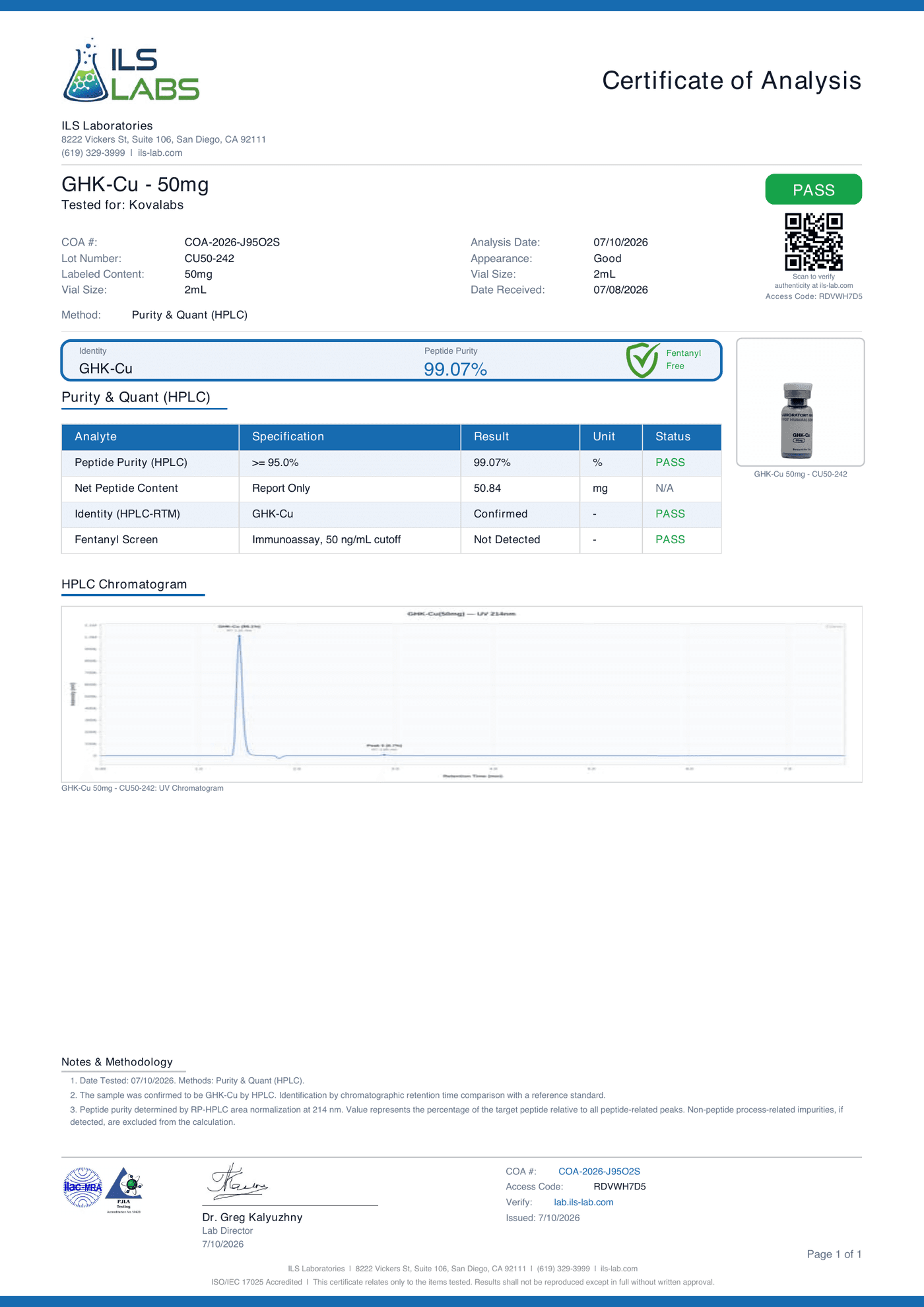
Read it narrowly and it stays honest. On the live GHK-Cu report above, lot CU50-242, the fentanyl line reads Not Detected. That means no fentanyl was found above the 50 ng/mL cutoff in that lot, by immunoassay, at the time of testing. It is a statement tied by lot number to that one batch, and it is verifiable: the QR code on the report resolves to the lab's own verification portal, so the result cannot simply be typed onto a nicer-looking PDF. The full certificate is published as a downloadable COA as well.
What the result does not do is travel outside its own boundaries. It says nothing about a different lot, an unscreened strength, or fitness for any use in a living body. The table below keeps the two columns apart.
| What "Not Detected" does say | What it does not say |
|---|---|
| No fentanyl above the 50 ng/mL cutoff in this specific lot | That the reagent is safe for human or animal use |
| A result tied by lot number to the batch on the COA | Anything about a different lot or an unscreened strength |
| A contaminant screened by immunoassay at an accredited lab | That every conceivable contaminant was screened |
Where does the fentanyl screen sit in the wider Kovalabs report?
The screen is one line inside a batch-specific report that also carries the analytics for the peptide itself. On the same document you get purity by RP-HPLC with the actual chromatogram shown rather than a bare number, identity by HPLC-RTM against a reference standard, and net peptide content measured per fill. The certificate is addressed "Tested for Kovalabs", which fixes the chain of custody: it is Kovalabs' own report tied to that batch, not a supplier's generic sheet and not a certificate borrowed from elsewhere. Every one of those checks, the fentanyl screen included, is a statement about the chemistry and contamination status of a research reagent, and nothing more. You can see the same report structure on the GHK-Cu product page and on siblings such as BPC-157. Handling from powder onward is a separate matter covered in the reconstitution guide.
Sources
- PubChem CID 3345, Fentanyl (C22H28N2O, molecular weight 336.5). National Center for Biotechnology Information.
- PubChem CID 71587328, GHK-Cu / Copper tripeptide-1 (C14H23CuN6O4+, molecular weight 402.92). National Center for Biotechnology Information.
- ILS Laboratories verification portal, Kovalabs GHK-Cu lot CU50-242 (fentanyl Not Detected).
- Kovalabs Certificate of Analysis (PDF), GHK-Cu lot CU50-242.
What is a fentanyl screen on a peptide COA?
It is a targeted contaminant test reported on the certificate of analysis. On a Kovalabs report it is an immunoassay run against a 50 ng/mL cutoff and reported as Detected or Not Detected. It is separate from the purity and identity tests, which describe the peptide itself rather than screening for an opioid contaminant.
Are research peptides tested for fentanyl as standard?
Usually not. Fentanyl screening is an additional assay that most COAs omit, so its presence on a certificate is itself a signal about how contamination is handled. Kovalabs runs the screen on every batch and every strength rather than on a single flagship product.
Why can a research peptide be contaminated with fentanyl?
Peptides are synthesised and handled in facilities and supply chains that are not sealed off from controlled substances, and poorly synthesised or carelessly handled material is where trace opioid contamination becomes a real possibility rather than a hypothetical. A screen removes the assumption that the risk is zero; it does not claim contamination is common.
What does "Not Detected" mean on a fentanyl screen?
It means no fentanyl was found above the 50 ng/mL cutoff in that specific lot, by immunoassay, at the time of testing. It is tied by lot number to one batch and says nothing about a different lot, an unscreened strength, or fitness for any use.
Does a clean fentanyl screen mean the peptide is safe to use?
No. A Not Detected result certifies the contamination status of a research reagent, not safety for use in a person or animal. Kovalabs peptides are supplied for laboratory research use only and hold no marketing authorisation as medicines.
Does every Kovalabs peptide get a fentanyl screen?
Yes. The screen is run on every batch and every variant, because a 5 mg fill and a 10 mg fill are different fills and each is documented on its own COA. The result can be checked against the lab's own verification portal via the QR code on the report.
Research use only
Research use only. Every Kovalabs peptide is supplied as a laboratory reference material and is not a medicine, supplement or cosmetic. A fentanyl screen certifies the contamination status of a research reagent; it makes no statement about safety or fitness for use in any human or animal, and nothing here is a benefit, dosing or outcome claim. See the research disclaimer for the full terms.