
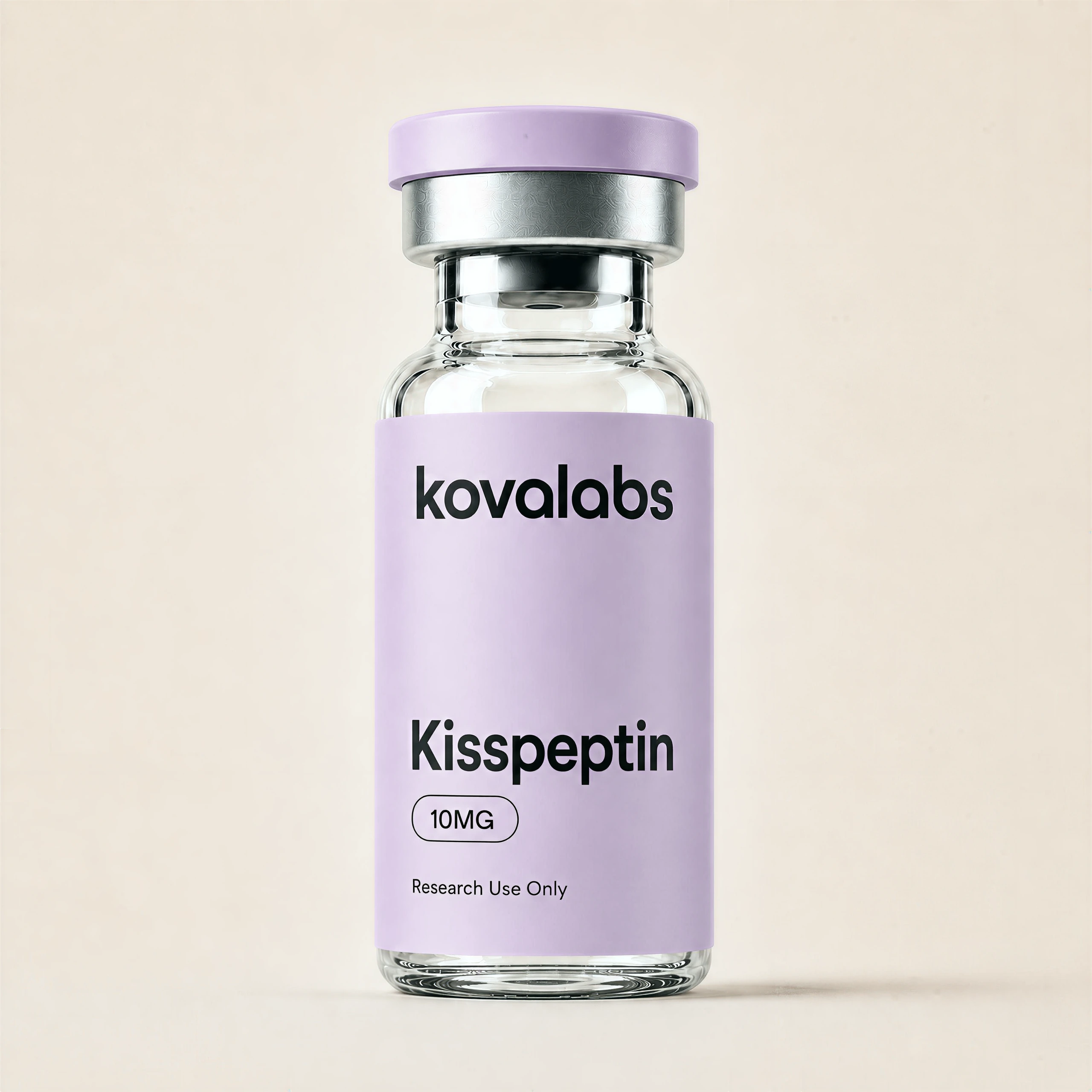
Kisspeptin-10 10mg
KS10-299
99.20%
Peptide purity
- Purity (HPLC)
- 99.20%
- Net peptide content
- 10.45 mg
- Identity (HPLC-RTM)
- Kisspeptin
- Fentanyl screen
- Not Detected
ILS LabsTested 18 Aug 2026
Research use only
Kovalabs supplies research-grade peptides to qualified researchers for laboratory use only. They are not medicines, are not for human or animal consumption, and are supplied with no dosing or medical guidance.
You must be 18 or over and a qualified person purchasing solely for scientific research.
Selecting ‘I agree’ confirms the above and your acceptance of our Research Disclaimer and Terms of Sale.
Manufactured for laboratory research. Not for human or veterinary use. Read full disclaimer →
Kisspeptin-10 is a synthetic decapeptide fragment of the KISS1 gene product, studied in research into KISS1R (GPR54) receptor signalling and hypothalamic GnRH-neuron pathways in experimental models.
Kisspeptin-10 is a synthetic decapeptide corresponding to residues 112-121 of the human KISS1 gene product, and an agonist at the kisspeptin receptor KISS1R (also catalogued as GPR54). Its sequence is Tyr-Asn-Trp-Asn-Ser-Phe-Gly-Leu-Arg-Phe-NH2 (YNWNSFGLRF-NH2), with molecular formula C63H83N17O14, molecular weight 1302.4 g/mol and CAS number 374675-21-5. It also appears in the literature as metastin 45-54. Kovalabs supplies it lyophilised as a research reference compound for laboratory use only.
The amide-capped C-terminal Arg-Phe motif is the part of the sequence the literature identifies as required for receptor recognition, and is characteristic of its identity within the RFamide peptide family. Kisspeptin-10 sits in the neuropeptides research category as a reference material, not as a medicine or supplement.
Kisspeptin-10 is not a controlled drug under the Misuse of Drugs Act 1971 and is not scheduled. It is supplied in the UK strictly as a research chemical for laboratory use only. It is not a licensed medicine, holds no marketing authorisation, and cannot be sold or supplied for human or veterinary consumption. The buyer is responsible for lawful, compliant handling under their own jurisdiction. See our research disclaimer.
Each batch is released after independent testing. Purity is assessed by HPLC at 99% or greater, and identity is confirmed against the expected mass for C63H83N17O14 (CAS 374675-21-5, PubChem CID 25240297). A batch-specific Certificate of Analysis accompanies the material; current documents are published on our CoA page. This verification is what separates a characterised reference compound from unverified material, which is why "is all kisspeptin the same" has a clear answer: only a CoA-backed batch is.
The published literature uses Kisspeptin-10 as a tool compound to probe KISS1R / GPR54 binding and the intracellular cascades it recruits, including ERK1/2 phosphorylation and calcium signalling, in receptor-transfected cell systems and in isolated hypothalamic GnRH neurons. Structure-activity work across kisspeptin analogues maps which residues drive receptor affinity. People searching for kisspeptin benefits or effects should note that none of this establishes any benefit, effect or outcome in humans; it is not a licensed medicine and no human or veterinary application is intended or implied.
Kisspeptin-10 acts at KISS1R, a receptor distinct from those studied with the other neuropeptides in this catalogue: Selank and Semax are short regulatory peptides investigated in separate central-signalling literature, and DSIP is a nonapeptide studied in its own right. PT-141 is a melanocortin-receptor ligand and is again mechanistically separate. These are identity and receptor comparisons only, not protocols and not any guidance for use in a body.
Kisspeptin-10 is supplied as a white to off-white lyophilised solid for reconstitution at the bench with a research solvent such as bacteriostatic water. Store lyophilised material at -20C, dry and protected from light; hold reconstituted material at 2-8C. Sold per vial as a product specification, despatched from the UK. For laboratory research use only; not for human or veterinary use.
Specifications for this product have not been published yet. Get in touch if you need the full data sheet for laboratory use.
Kisspeptin-10 10mg
KS10-299
99.20%
Peptide purity
Pairs with this
Great honest company
Was recommended by a family member, and now I recommend to everyone I know. Fantastic company, with very intense testing. Fast delivery, quality products. Thank you kovalabs!!
Love kovalabs. Great products & customer service. Highly recommend.
The kovalabs team deserves some sort of award. By far the best customer support I’ve received perhaps in my life, with genuinely kind and caring people. The vials themselves look very premium and professional, but more importantly I can vouch that the quality of the stuff is truly top tier. I continue to recommend to all
Excellent company
I wanted to leave a review based on the exceptional customer service I received. Long story short, my package was delayed due to the courier (not kovalabs fault), when I got in touch, Charlotte responded instntly, proffesionally and she went completely above and beyond my expectations in putting the situation right. I dont think I remember another time where a company has acted in the way they have with me. Absolutely brilliant. A* all around. Plus when the prducts did come, everything was exceptionally packaged with a little hand written note too. Again, highly recommended to anyone who value's quality products from a quality company.
Very happy, thanks.
Professional Service and great products.
Really impressed with my experience overall. The ordering process was straightforward, shipping was quicker than I had paid for, and everything arrived packaged professionally. Definitely earned my trust as a repeat customer
Standout company!
Very happy with my order, already placed my next. Cheers.
Trustworthy & High Quality Experience
To know the peptides have been third party verified and you can see the actual certificate is huge to me! I trust what I am getting is legit. Support is superb too I must say.